Kushal
May 9, 2026
The Adoption Gap Nobody Talks About
Leadership buys the licenses. IT deploys the tools. A company-wide email goes out. And then, months later, when someone finally measures usage, the number is almost always the same: most of the team never actually opened it.
This is not a technology problem. It is a workflow problem. People do not change how they work because a new subscription appeared in their app store. They change when the new way of working is easier than the old way.
The data on this is stark. According to Gallup research from mid-2024:
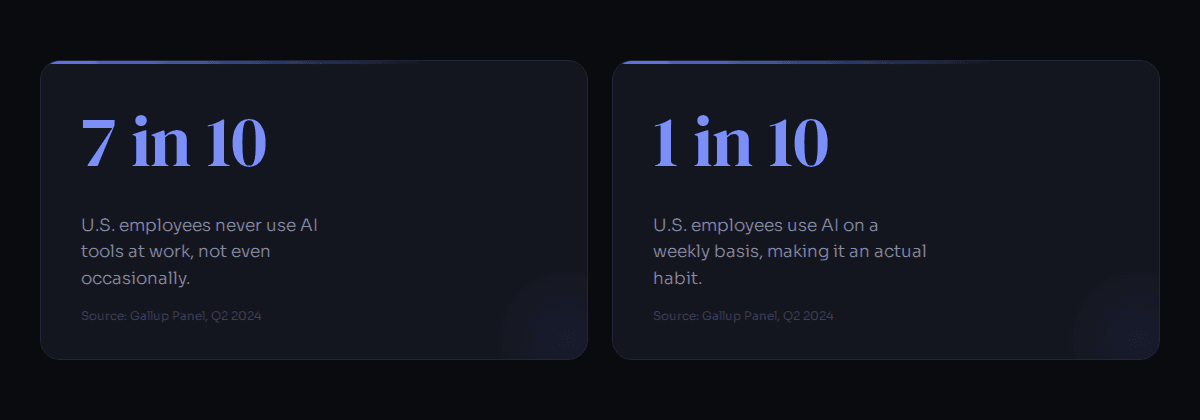
This gap exists at companies that have already invested in AI. It is not a question of access. It is a question of integration. And the root cause is fragmentation.
The average knowledge worker toggles between apps more than 300 times per day. Context-switching is not just annoying. It is the single biggest reason new tools never stick.
Fragmentation is the villain. Not your people.
Fragmentation Is the Villain, Not Your People
Here is what actually happens when someone tries to use an AI tool at work. They have Slack open, Gmail open, Notion, a calendar, a project tracker, and maybe ChatGPT or Gemini in a separate tab. The AI tool is one more thing to context-switch into. So they do not.
The cognitive overhead of managing scattered tools forces people to take the path of least resistance, which is their existing habits. Adoption fails not because the tools are bad, but because the environment they land in is already overloaded.
This is exactly the problem Floutwork is built to solve. Not by replacing your tools, but by pulling them into a single hub where AI sits alongside your actual work context. No tab-switching. No lost threads. One surface where everything already lives.
Most AI Strategies Focus on the Wrong Layer
Gallup's research also found that only 15% of U.S. workers strongly agree their organization has a clear AI integration strategy that connects to how they actually work each day.
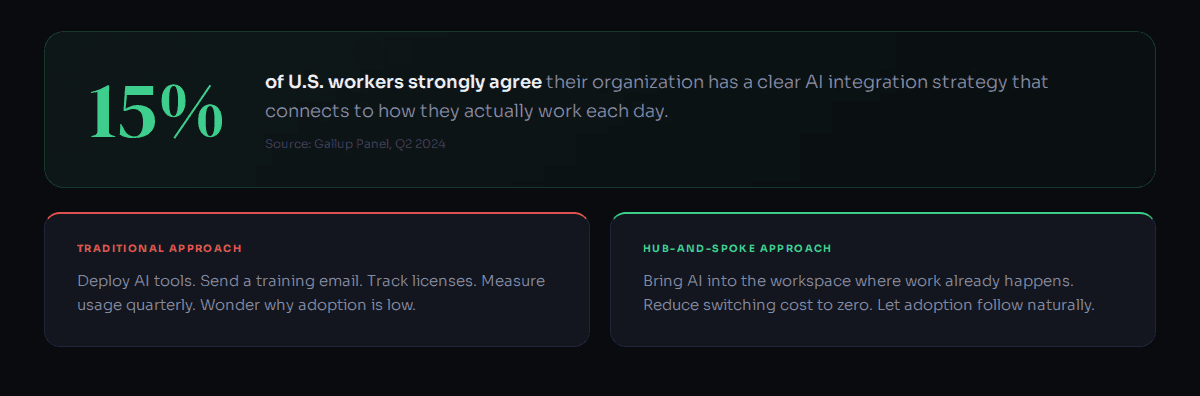
Leadership is spending on the tools layer. Almost nobody is investing in the workflow layer.
The companies pulling ahead are not just buying better AI tools. They are rethinking the environment in which work happens. They are asking: where do people spend most of their day, and how do we bring AI there, rather than expecting people to go find AI somewhere else.
The Four Stages of Real AI Adoption
Getting from "we have AI tools" to "our team actually uses them" requires moving through four distinct stages. Skipping any one of them is why most adoption programs stall.
1. Establish a baseline
Know where your team actually stands before doing anything else. How many people have used an AI tool in the last 30 days? What stops them? You cannot close a gap you have not measured.
2. Reduce friction at the environment level
Stop asking people to leave their workflow to use AI. Bring AI into the hub where they already work. When ChatGPT, Gemini, and your internal tools are one click away inside the same workspace as Slack and email, usage follows without mandates.
3. Enable managers, not just individual contributors
AI habits form through teams, not individuals. When managers model usage and build AI touchpoints into team rituals, adoption spreads laterally. Manager enablement is the highest-leverage investment most organizations skip.
4. Remove barriers continuously
Adoption is not a one-time initiative. It is an ongoing feedback loop. The organizations that sustain momentum are the ones that keep listening for what still feels hard and keep making it easier.
What a Hub Actually Changes
Floutwork is built on a simple premise: the workspace is the strategy. When Slack, Gmail, Notion, Linear, Calendar, Google Drive, ChatGPT, and Gemini all live inside one hub, the adoption problem changes shape entirely.
Instead of asking your team to build a new habit around a standalone AI tool, you reduce the cost of using AI to zero context-switching. The AI is already there, inside the workflow, not two tabs away from it. That is the difference between a tool your team knows about and a tool your team actually uses.
The organizations moving fastest on AI transformation are not the ones with the biggest software budgets. They are the ones that made AI the easiest option, not an additional one.
Kushal
May 9, 2026
The Adoption Gap Nobody Talks About
Leadership buys the licenses. IT deploys the tools. A company-wide email goes out. And then, months later, when someone finally measures usage, the number is almost always the same: most of the team never actually opened it.
This is not a technology problem. It is a workflow problem. People do not change how they work because a new subscription appeared in their app store. They change when the new way of working is easier than the old way.
The data on this is stark. According to Gallup research from mid-2024:
This gap exists at companies that have already invested in AI. It is not a question of access. It is a question of integration. And the root cause is fragmentation.
The average knowledge worker toggles between apps more than 300 times per day. Context-switching is not just annoying. It is the single biggest reason new tools never stick.
Fragmentation is the villain. Not your people.
Fragmentation Is the Villain, Not Your People
Here is what actually happens when someone tries to use an AI tool at work. They have Slack open, Gmail open, Notion, a calendar, a project tracker, and maybe ChatGPT or Gemini in a separate tab. The AI tool is one more thing to context-switch into. So they do not.
The cognitive overhead of managing scattered tools forces people to take the path of least resistance, which is their existing habits. Adoption fails not because the tools are bad, but because the environment they land in is already overloaded.
This is exactly the problem Floutwork is built to solve. Not by replacing your tools, but by pulling them into a single hub where AI sits alongside your actual work context. No tab-switching. No lost threads. One surface where everything already lives.
Most AI Strategies Focus on the Wrong Layer
Gallup's research also found that only 15% of U.S. workers strongly agree their organization has a clear AI integration strategy that connects to how they actually work each day.
Leadership is spending on the tools layer. Almost nobody is investing in the workflow layer.
The companies pulling ahead are not just buying better AI tools. They are rethinking the environment in which work happens. They are asking: where do people spend most of their day, and how do we bring AI there, rather than expecting people to go find AI somewhere else.
The Four Stages of Real AI Adoption
Getting from "we have AI tools" to "our team actually uses them" requires moving through four distinct stages. Skipping any one of them is why most adoption programs stall.
1. Establish a baseline
Know where your team actually stands before doing anything else. How many people have used an AI tool in the last 30 days? What stops them? You cannot close a gap you have not measured.
2. Reduce friction at the environment level
Stop asking people to leave their workflow to use AI. Bring AI into the hub where they already work. When ChatGPT, Gemini, and your internal tools are one click away inside the same workspace as Slack and email, usage follows without mandates.
3. Enable managers, not just individual contributors
AI habits form through teams, not individuals. When managers model usage and build AI touchpoints into team rituals, adoption spreads laterally. Manager enablement is the highest-leverage investment most organizations skip.
4. Remove barriers continuously
Adoption is not a one-time initiative. It is an ongoing feedback loop. The organizations that sustain momentum are the ones that keep listening for what still feels hard and keep making it easier.
What a Hub Actually Changes
Floutwork is built on a simple premise: the workspace is the strategy. When Slack, Gmail, Notion, Linear, Calendar, Google Drive, ChatGPT, and Gemini all live inside one hub, the adoption problem changes shape entirely.
Instead of asking your team to build a new habit around a standalone AI tool, you reduce the cost of using AI to zero context-switching. The AI is already there, inside the workflow, not two tabs away from it. That is the difference between a tool your team knows about and a tool your team actually uses.
The organizations moving fastest on AI transformation are not the ones with the biggest software budgets. They are the ones that made AI the easiest option, not an additional one.