Kushal
May 7, 2026
You approved the budget. You signed the contracts. You gave your team access to the AI tools. And yet, three months later, adoption is patchy at best. Some people use it daily, most barely touch it, and you're not sure the investment is doing anything measurable.
This is not a people problem. It is a workflow problem.
And it has a name: AI sprawl.
The Sprawl Problem Nobody Talks About
When organizations adopt AI, they rarely adopt one tool. They adopt several. ChatGPT for writing. Gemini for research. Copilot embedded in Office. A specialized model for data. Another one for customer support.
Each of these tools works well in isolation. The problem is that none of them live where the actual work happens. They sit in separate tabs, separate windows, separate mental contexts. Your team has to remember to switch over to them, copy information in, get an output, then context-switch back to whatever they were doing.
That friction sounds small. Multiply it across a hundred people doing it dozens of times a day, and it becomes the reason AI adoption quietly dies.
The tool is not the obstacle. The distance between the tool and the work is.
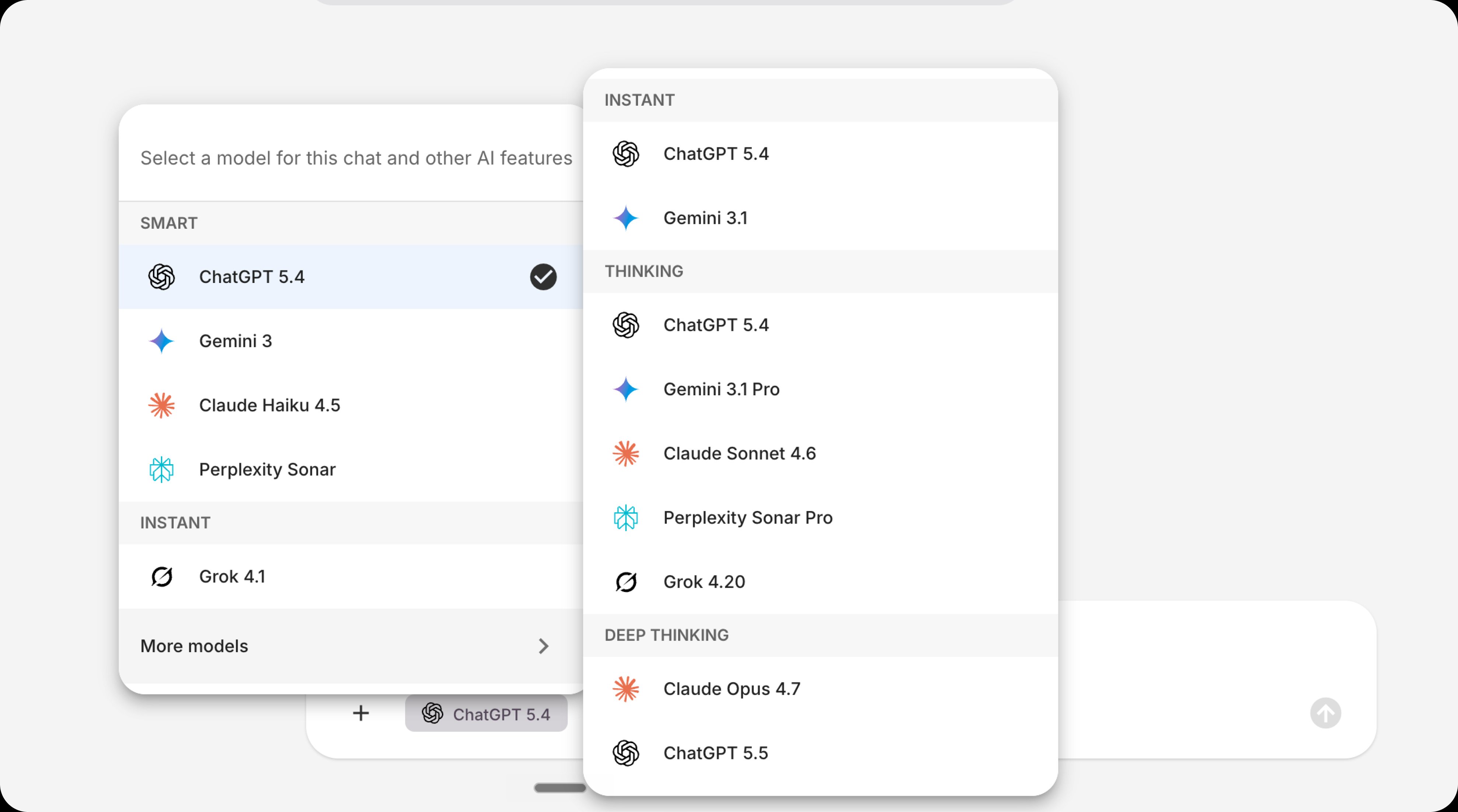
Floutwork lets you switch between ChatGPT, Gemini, Claude, Perplexity and more from a single unified workspace — no tab switching required.
What "Stalled" Actually Looks Like
When IT and transformation leaders tell me their AI rollout is underperforming, the symptoms are almost always the same.
Usage is inconsistent. A handful of power users drive most of the activity, while everyone else reverts to old habits within a few weeks. Not because they are resistant to AI, but because the habit formation never took hold. The tool was always one more thing to open rather than a natural part of how they worked.
Results are disconnected from context. When AI lives in a separate surface, it has no awareness of what is actually happening in your organization. It cannot see the Slack thread, the Linear ticket, the email chain. You have to paste all of that in manually every single time. Most people stop bothering.
Security and governance get complicated. When employees are toggling between five different AI products, IT loses visibility into what data is going where. Shadow AI becomes a real risk not because employees are reckless, but because the approved tools are too inconvenient to use consistently.
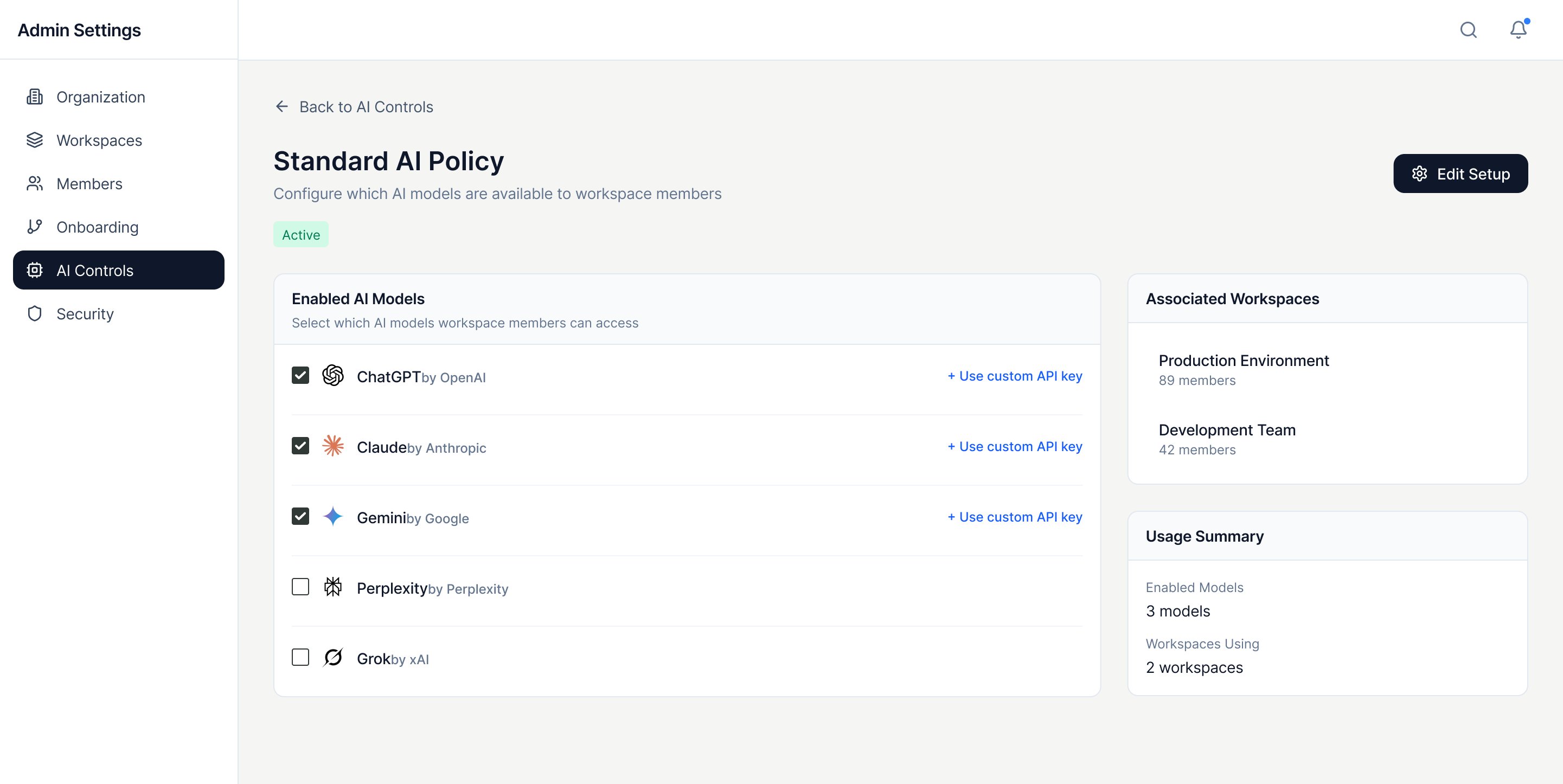
Floutwork's Admin AI Controls lets IT teams configure exactly which AI models are available across workspaces — with full usage visibility in one place.
These are not failures of ambition. They are failures of integration.
The Unified Workspace Shift
The organizations seeing real ROI from AI are not necessarily using better models. They are using AI in a fundamentally different way. It is embedded in the same environment where communication, planning, and execution happen.
Think about what that actually changes.
When your AI is sitting next to your Slack, Gmail, Notion, and Linear in one hub, the barrier to using it drops to near zero. There is no context-switching cost. There is no manual copy-paste ritual. You ask a question, get an answer, and keep moving. The habit forms because the friction is gone.
When the workspace is unified, AI also has access to the right context by default. It knows what project you are working on. It can reference the conversation thread. It can pull from the document you have open. The output becomes useful in a way that isolated AI never quite manages.
And from a governance perspective, a unified workspace means IT has one place to monitor, one set of access controls to manage, one surface to audit. The sprawl collapses into something observable and controllable.
Why This Matters Right Now
Enterprise AI is at an inflection point. The organizations that get integration right in the next 12 to 18 months will compound their advantage quickly. The ones still managing sprawl will keep spending on tools that underperform not because the AI is bad, but because it is sitting in the wrong place.
The question is not whether to use AI. That decision has already been made. The question is whether the infrastructure around it is set up to make adoption real and durable.
A unified workspace is not a luxury feature for forward-thinking teams. It is the baseline condition for AI to actually work at scale.
A Note on Floutwork
This is exactly the problem Floutwork is built to solve. It is a unified workspace that aggregates your productivity apps, communication tools, and AI models into a single hub. Built to eliminate context-switching and help modern teams do their best work without the noise. If your organization is in the middle of an AI rollout and hitting the adoption wall, it is worth taking a look.
Kushal
May 7, 2026
You approved the budget. You signed the contracts. You gave your team access to the AI tools. And yet, three months later, adoption is patchy at best. Some people use it daily, most barely touch it, and you're not sure the investment is doing anything measurable.
This is not a people problem. It is a workflow problem.
And it has a name: AI sprawl.
The Sprawl Problem Nobody Talks About
When organizations adopt AI, they rarely adopt one tool. They adopt several. ChatGPT for writing. Gemini for research. Copilot embedded in Office. A specialized model for data. Another one for customer support.
Each of these tools works well in isolation. The problem is that none of them live where the actual work happens. They sit in separate tabs, separate windows, separate mental contexts. Your team has to remember to switch over to them, copy information in, get an output, then context-switch back to whatever they were doing.
That friction sounds small. Multiply it across a hundred people doing it dozens of times a day, and it becomes the reason AI adoption quietly dies.
The tool is not the obstacle. The distance between the tool and the work is.
Floutwork lets you switch between ChatGPT, Gemini, Claude, Perplexity and more from a single unified workspace — no tab switching required.
What "Stalled" Actually Looks Like
When IT and transformation leaders tell me their AI rollout is underperforming, the symptoms are almost always the same.
Usage is inconsistent. A handful of power users drive most of the activity, while everyone else reverts to old habits within a few weeks. Not because they are resistant to AI, but because the habit formation never took hold. The tool was always one more thing to open rather than a natural part of how they worked.
Results are disconnected from context. When AI lives in a separate surface, it has no awareness of what is actually happening in your organization. It cannot see the Slack thread, the Linear ticket, the email chain. You have to paste all of that in manually every single time. Most people stop bothering.
Security and governance get complicated. When employees are toggling between five different AI products, IT loses visibility into what data is going where. Shadow AI becomes a real risk not because employees are reckless, but because the approved tools are too inconvenient to use consistently.
Floutwork's Admin AI Controls lets IT teams configure exactly which AI models are available across workspaces — with full usage visibility in one place.
These are not failures of ambition. They are failures of integration.
The Unified Workspace Shift
The organizations seeing real ROI from AI are not necessarily using better models. They are using AI in a fundamentally different way. It is embedded in the same environment where communication, planning, and execution happen.
Think about what that actually changes.
When your AI is sitting next to your Slack, Gmail, Notion, and Linear in one hub, the barrier to using it drops to near zero. There is no context-switching cost. There is no manual copy-paste ritual. You ask a question, get an answer, and keep moving. The habit forms because the friction is gone.
When the workspace is unified, AI also has access to the right context by default. It knows what project you are working on. It can reference the conversation thread. It can pull from the document you have open. The output becomes useful in a way that isolated AI never quite manages.
And from a governance perspective, a unified workspace means IT has one place to monitor, one set of access controls to manage, one surface to audit. The sprawl collapses into something observable and controllable.
Why This Matters Right Now
Enterprise AI is at an inflection point. The organizations that get integration right in the next 12 to 18 months will compound their advantage quickly. The ones still managing sprawl will keep spending on tools that underperform not because the AI is bad, but because it is sitting in the wrong place.
The question is not whether to use AI. That decision has already been made. The question is whether the infrastructure around it is set up to make adoption real and durable.
A unified workspace is not a luxury feature for forward-thinking teams. It is the baseline condition for AI to actually work at scale.
A Note on Floutwork
This is exactly the problem Floutwork is built to solve. It is a unified workspace that aggregates your productivity apps, communication tools, and AI models into a single hub. Built to eliminate context-switching and help modern teams do their best work without the noise. If your organization is in the middle of an AI rollout and hitting the adoption wall, it is worth taking a look.