Kushal
May 11, 2026
The Onboarding Problem Nobody Wants to Admit
Someone starts their first day. HR has sent a welcome email with twelve links. IT has raised four access tickets that will take three to five business days. The new hire has a laptop, a login, and absolutely no idea where to begin.
This plays out at companies of every size, every week. And the cost is real. According to Gallup, employees who experience poor onboarding are twice as likely to look for another opportunity within a year. Getting someone hired is expensive. Losing them because their first week was chaotic is worse.
The root cause is not that companies do not care about onboarding. It is that onboarding is still built on fragmentation. Tools live in different places. Certifications are sent as links. Account access depends on IT queues. Nothing is connected, and the new hire is expected to piece it together themselves.
Fragmentation is the villain. Not your HR team. Not your IT team.
What Broken Onboarding Actually Costs
Most organizations measure onboarding success by whether the paperwork got signed and the accounts got created. That is the wrong metric.
The real cost shows up later. A new hire who spends their first two weeks waiting for access, hunting for the right tools, and asking where things live is not just frustrated. They are unproductive. And that lost productivity compounds every day the environment is not ready.
For the HR person, broken onboarding means fielding the same questions from every new hire. For IT, it means manually replicating the same setup process for each person who joins. For the COO or Ops Leader watching headcount grow, it means the time-to-productivity number never improves no matter how much the team grows.
The overhead is not in hiring. It is in the setup that happens after.
Most Onboarding Tools Solve the Wrong Problem
The market is full of onboarding checklists, HRIS platforms, and document portals. Most of them digitize the old process rather than replace it. The new hire still has to navigate between systems. IT still has to grant access manually. The workspace still has to be assembled from scratch.
What nobody has solved is the environment problem. A new hire does not just need a checklist of tasks. They need a fully configured workspace waiting for them on day one, with the tools, AI assistants, certifications, and workflows already in place, so they can actually start working instead of spending a week getting ready to work.
That is a fundamentally different approach. And it is the one Floutwork is built around.
What One-Click Onboarding Actually Looks Like
Floutwork's onboarding feature starts from a simple premise: by the time a new hire opens the tool, everything should already be there.
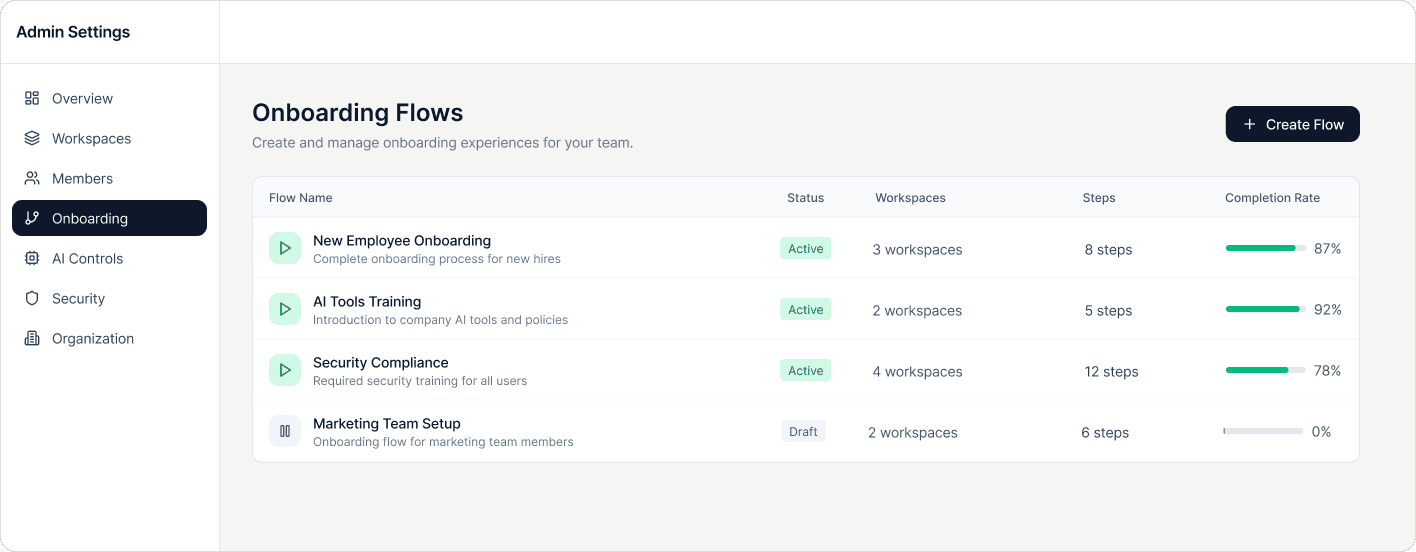
When a new employee joins, they download Floutwork. That is it. Inside, their workspace is fully configured. Their tools are connected. Their AI assistants are set up. The certifications they need to complete are queued and ready. The accounts they need access to are already linked. The workflows their team uses are already in place.
Instead of sending a new hire forty-seven links and hoping they follow up, you hand them one tool and everything is already inside it.
For HR, this means the onboarding process is consistent every single time. No manual coordination, no forgotten steps, no new hire slipping through the cracks. For IT, it means setup is not a per-person manual task anymore. For the COO, it means a new hire can be contributing in days, not weeks.
The Four Things a New Hire Needs on Day One
Getting someone productive fast requires more than access. It requires four things to be in place before they even open their laptop.
1. A pre-configured workspace
The tools they will use every day should already be connected and waiting. Slack, Gmail, Notion, Linear, Calendar, Google Drive, and any AI tools the team uses should be one click away, not buried in a setup guide.
2. Structured certifications and training
Every new hire has things they need to learn and verify before they can operate independently. Security training, compliance modules, product overviews, whatever your team requires should be queued inside their workspace in the right order, with progress tracked automatically.
3. Clear workflow context
A new hire who does not know how the team operates wastes weeks asking questions that should have been answered on day one. When the workflows are already embedded in the workspace, the context comes with the environment.
4. Zero dependence on IT tickets
Every time a new hire has to wait for IT to grant access, productivity stops. Onboarding that requires manual IT intervention at each step is not scalable. The setup should happen once, at the environment level, not once per person.
The Workspace Is the Onboarding
Floutwork is built on the same premise that drives everything else we build: the workspace is the strategy.
When the workspace is already configured before day one, onboarding stops being a coordination problem and becomes an experience. New hires arrive to an environment that is ready for them. HR stops fielding the same questions. IT stops replicating the same setup. And the COO sees the number they actually care about, time-to-productivity, start to move.
The companies that onboard well are not the ones with the most detailed checklists. They are the ones that made the environment ready before the person arrived.
Kushal
May 11, 2026
The Onboarding Problem Nobody Wants to Admit
Someone starts their first day. HR has sent a welcome email with twelve links. IT has raised four access tickets that will take three to five business days. The new hire has a laptop, a login, and absolutely no idea where to begin.
This plays out at companies of every size, every week. And the cost is real. According to Gallup, employees who experience poor onboarding are twice as likely to look for another opportunity within a year. Getting someone hired is expensive. Losing them because their first week was chaotic is worse.
The root cause is not that companies do not care about onboarding. It is that onboarding is still built on fragmentation. Tools live in different places. Certifications are sent as links. Account access depends on IT queues. Nothing is connected, and the new hire is expected to piece it together themselves.
Fragmentation is the villain. Not your HR team. Not your IT team.
What Broken Onboarding Actually Costs
Most organizations measure onboarding success by whether the paperwork got signed and the accounts got created. That is the wrong metric.
The real cost shows up later. A new hire who spends their first two weeks waiting for access, hunting for the right tools, and asking where things live is not just frustrated. They are unproductive. And that lost productivity compounds every day the environment is not ready.
For the HR person, broken onboarding means fielding the same questions from every new hire. For IT, it means manually replicating the same setup process for each person who joins. For the COO or Ops Leader watching headcount grow, it means the time-to-productivity number never improves no matter how much the team grows.
The overhead is not in hiring. It is in the setup that happens after.
Most Onboarding Tools Solve the Wrong Problem
The market is full of onboarding checklists, HRIS platforms, and document portals. Most of them digitize the old process rather than replace it. The new hire still has to navigate between systems. IT still has to grant access manually. The workspace still has to be assembled from scratch.
What nobody has solved is the environment problem. A new hire does not just need a checklist of tasks. They need a fully configured workspace waiting for them on day one, with the tools, AI assistants, certifications, and workflows already in place, so they can actually start working instead of spending a week getting ready to work.
That is a fundamentally different approach. And it is the one Floutwork is built around.
What One-Click Onboarding Actually Looks Like
Floutwork's onboarding feature starts from a simple premise: by the time a new hire opens the tool, everything should already be there.
When a new employee joins, they download Floutwork. That is it. Inside, their workspace is fully configured. Their tools are connected. Their AI assistants are set up. The certifications they need to complete are queued and ready. The accounts they need access to are already linked. The workflows their team uses are already in place.
Instead of sending a new hire forty-seven links and hoping they follow up, you hand them one tool and everything is already inside it.
For HR, this means the onboarding process is consistent every single time. No manual coordination, no forgotten steps, no new hire slipping through the cracks. For IT, it means setup is not a per-person manual task anymore. For the COO, it means a new hire can be contributing in days, not weeks.
The Four Things a New Hire Needs on Day One
Getting someone productive fast requires more than access. It requires four things to be in place before they even open their laptop.
1. A pre-configured workspace
The tools they will use every day should already be connected and waiting. Slack, Gmail, Notion, Linear, Calendar, Google Drive, and any AI tools the team uses should be one click away, not buried in a setup guide.
2. Structured certifications and training
Every new hire has things they need to learn and verify before they can operate independently. Security training, compliance modules, product overviews, whatever your team requires should be queued inside their workspace in the right order, with progress tracked automatically.
3. Clear workflow context
A new hire who does not know how the team operates wastes weeks asking questions that should have been answered on day one. When the workflows are already embedded in the workspace, the context comes with the environment.
4. Zero dependence on IT tickets
Every time a new hire has to wait for IT to grant access, productivity stops. Onboarding that requires manual IT intervention at each step is not scalable. The setup should happen once, at the environment level, not once per person.
The Workspace Is the Onboarding
Floutwork is built on the same premise that drives everything else we build: the workspace is the strategy.
When the workspace is already configured before day one, onboarding stops being a coordination problem and becomes an experience. New hires arrive to an environment that is ready for them. HR stops fielding the same questions. IT stops replicating the same setup. And the COO sees the number they actually care about, time-to-productivity, start to move.
The companies that onboard well are not the ones with the most detailed checklists. They are the ones that made the environment ready before the person arrived.